THE FUTURE ATHLETE PROGRAM
Your child already has a sports coach. But who is developing the athlete behind the sport?
Young athletes don’t just need another training program. They need to learn how to become an athlete.
How to move well. How to build strength safely. How to train with purpose. How to handle pressure and setbacks. How to build confidence. And eventually, how to take ownership of their own development.
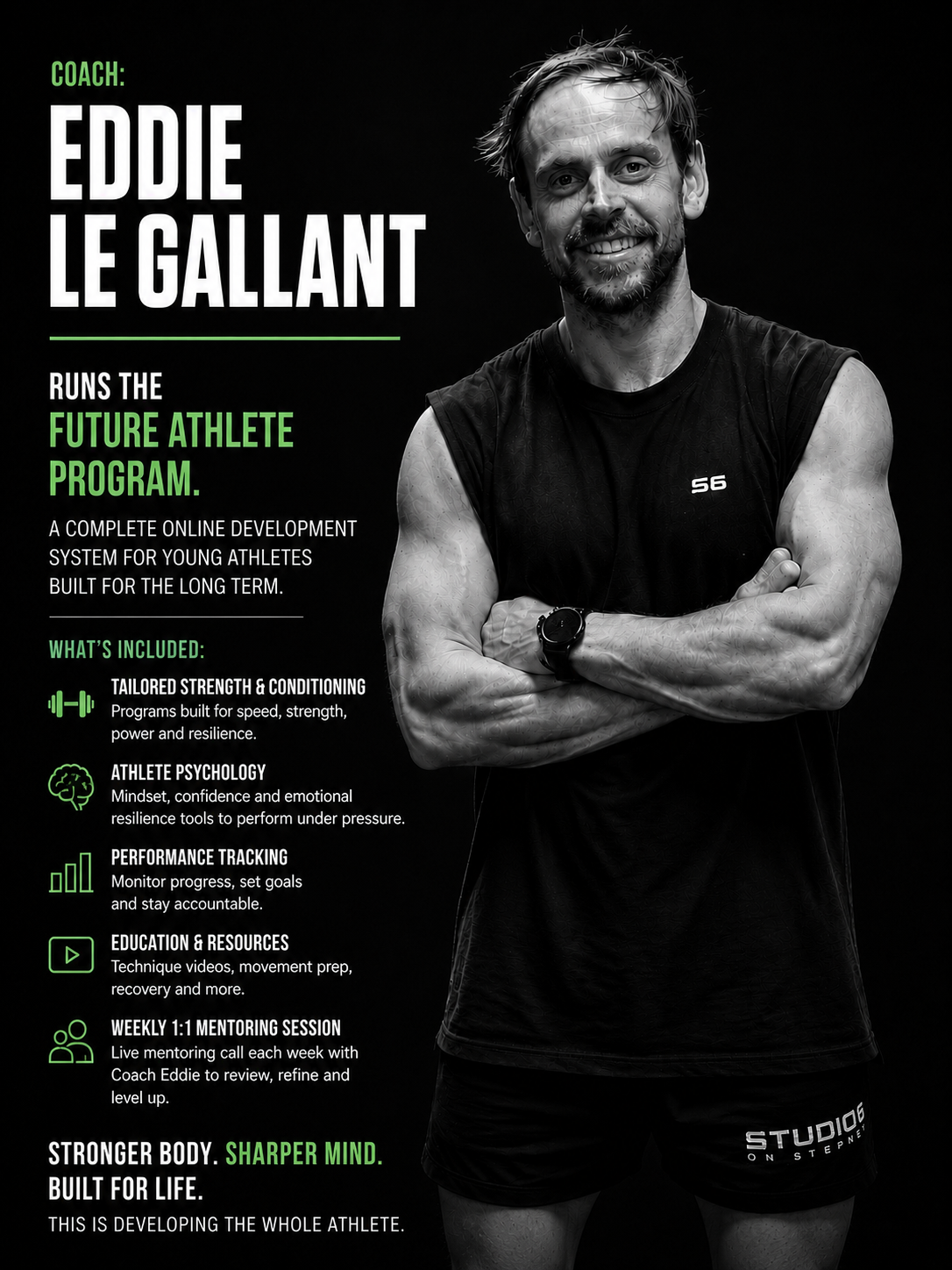
The Future Athlete Program brings personalised strength & conditioning, athletic development and performance psychology together in one complete coaching system — built around the individual athlete, their sport, their stage of development and the demands of their life.
Every athlete follows their own program, tracks their development and has a 1:1 mentoring session with me every week.
We talk about more than training.
We talk about confidence. Pressure. Discipline. Setbacks. School. Recovery. Expectations. Motivation. Their sport. Their goals. And the person they are becoming through it all.
Because developing a young athlete isn’t simply about making them stronger.
It’s about helping them develop the physical capability, psychological skills and personal responsibility to become the best athlete they are capable of becoming.
BUILD THE ATHLETE. NOT JUST THE MUSCLE.
Understand the person who is becoming the athlete.
For adolescents especially, psychology sits inside a complicated system.
They are not just learning how to train, compete and perform. They are trying to understand who they are while their body, relationships, responsibilities and expectations are changing around them.
Every young athlete is managing more than their sport:
Identity — Who am I, and how much of my identity is tied to being an athlete?
Autonomy — Am I doing this because I want to, or because other people expect me to?
Confidence — What happens to my belief in myself when I perform badly?
Competence — Do I feel capable, or constantly behind everyone around me?
Comparison — Am I measuring my progress against teammates, opponents and what I see online?
Success and failure — What does winning mean to me? What does losing make me believe about myself?
Parental expectations — Am I trying to perform for myself, or trying not to disappoint someone else?
Coach relationships — Do I feel supported, challenged, understood and safe enough to make mistakes?
Peer pressure and belonging — Where do I fit within my team, school and friendship groups?
School pressure — Training and competition don't remove assignments, exams and academic expectations.
Physical maturation — Their body may be changing faster than their ability to understand or control it.
Injury and selection — How do they respond when sport is temporarily taken away, or when somebody else gets picked?
Motivation — What keeps them training when improvement slows down?
Responsibility — Are they beginning to take ownership of their preparation, recovery and development?
Life load — Sleep, study, travel, sport, family, friendships and recovery all compete for the same finite resources.
This is why the psychology component of Future Athlete starts with understanding the athlete before attempting to change them.
We want to know what drives them, what pressures them, where their confidence comes from, how they respond to failure, how they interpret success and what kind of person they are becoming through sport.
Because developing a young athlete isn't simply about creating a stronger body.
It is helping them build the psychological skills to carry that body into competition, adversity and eventually adulthood.